Find a domain name now!

Friday, March 30, 2012

Biochemical Puzzles

Puzzle 1: Find seven hydrosoluble vitamins
N X S Y R F Q V W C B Y Q E R

N I L T O O H G O W I K W N Z

D K V L P S L C Y U O D N I L

E Q A A L R S Q W L T K L X V

N T V T L M A U I O I X K O G

O S T D K F N R N J N Y O D W

N A H Q S S O I F L X O H I I

F I D M K A M B R C Y M L R W

V Q A R H A M D I C K W U Y T

Q X V C L T W Y W R O X Q P Q

O A D A I T H I A M I N E T P

A F B Q Z N E Z T S V Q H Z V

P O S S N W A T Y M U U C M U

C B Q X T Z V B K X O G Q S W

P E W M X E J S F J P R H H Q


Puzzle 2: Carbohydrate Crossword

(Tip: save the crossword as a picture and print it. Then use a pencil to solve it) 
image


Across

3. Minor disaccharide that can be obtained from starch hydrolysis

5. The main kind of carbohydrate in foods. Also the way in which glucose is stored in plants.

7. The way in which glucose is stored in animals

12. The ketotriose

14. A ketohexose

15. Milk sugar

16. Pentose forming DNA

17. A polyalcohol related to the formation of cataracts in diabetic patients

18. An amino sugar

19. A tetrose

20. A polyalcohol related to the formation of cataracts in patients with galactosemia

21. C-2 epimer of glucose


Down

1. The lineal molecule found in starch granules

2. A heteropolysaccharide with anticoagulant effects.

4. A heptose

5. Table sugar

6. An aldohexose found in lactose

8. “Blood sugar”

9. An aldotriose

10. The branched molecule forming starch granules

11. Pentose forming RNA

13. Polysaccharide with a structural rol in plants

21. Main disaccharide obtained from starch hydrolysis


Puzzle 3: Organize the tiles!


When you organize these tiles, you will find a phrase describing a feature of biological catalysts, that in fact is common to all catalysts:


image


Puzzle4: Solve this amino acid crossword:


image ACROSS

1. amino acid positively charged at physiological pH
3. acidic amino acid
6. amino acid that can form disulfide bridges
7. aromatic amino acid
8. basic amino acid
10. polymer of amino acids
11. branched chain amino acid
12. amino acid with OH group in the lateral chain


DOWN

1. apolar amino acid
2. polar, non charged, amino acid
4. negatively charged amino acid at physiological pH
5. imino acid
9. the smallest amino acid


Puzzle 5: Find the names of ten carbohydrates:

image


Puzzle 6: Find the metabolites of the Krebs Cycle:


image 
SOLUTIONS

Puzzle 1:SOLUTION TO CARBOHYDRATE PUZZLE

GLUCOSE           GLYCOGEN           MALTOSE           RIBOSE

FRUCTOSE        ERYTHROSE         SUCROSE          GLYCERALDEHYDE

GALACTOSE       LACTOSE

image

Puzzle2: SOLUTION TO KREBS CYCLE METABOLITES PUZZLE:

SUCCINYLCOA                        SUCCINATE                          ALFAKETOGLUTARATE
MALATE                                    CITRATE                               FUMARATE
ISOCITRATE                            OXALACETATE                    ACETYLCOAA

image


Puzzle 3: Solution to the Tiles problem about biological catalysts

Organizing Tiles: Q: When you organize these tiles, you will find a phrase describing a feature   of biological catalysts, that in fact is common to all catalysts


Puzzle 4:  ENZ/YME/S D/O N/OT /CHA/NGE/ TH/E E/QUI/LIB/RIU/M O/F T/HE / REA/CTI/ ONS


Puzzle 5: Solution to:Find seven vitamins


BIOTIN

COBALAMIN

FOLATO

NIACIN

PYRIDOXINE

RIBOFLAVIN

THIAMINE
 

N + + + + F + + + + B + + E +

+ I + + O + + + + + I + + N +

+ + V L + + + + + + O + + I +

+ + A A + + + + + + T + + X +

+ T + + L + + + + + I + + O +

O + + + + F + + N + N + + D +

N + + + + + O I + + + + + I +

+ I + + + + M B + + + + + R +

+ + A + + A + + I + + + + Y +

+ + + C L + + + + R + + + P +

+ + + A I T H I A M I N E + +

+ + B + + N + + + + + + + + +

+ O + + + + + + + + + + + + +

C + + + + + + + + + + + + + +

+ + + + + + + + + + + + + + +
 

(Over,Down,Direction)

BIOTIN(11,1,S)

COBALAMIN(1,14,NE)

FOLATO(6,1,SW)

NIACIN(1,7,SE)

PYRIDOXINE(14,10,N)

RIBOFLAVIN(10,10,NW)

THIAMINE(6,11,E)

Polysaccharides

Polysaccharides are carbohydrates formed by more than 9 monosaccharides linked by glycosidic bonds.

When they are formed by the same kind of monosaccharides, they are called homopolysaccharides, like starch, glycogen and cellulose, formed each of them by hundreds of molecules of glucose linked by glycosidic linkages.

If the polysaccharides molecules are formed by different kinds of monosaccharides, they are considered heteropolysaccharides. Hyaluronic acid, formed by thousands of alternative units of N-acetyl glucosamine and glucuronic acid, is an example of heteropolysaccharide.  

HOMOPOLYSACCHARIDES:

Cellulose

Cellulose is a linear polymer of D-glucose residues bonded by b(1, 4)-O-glycosidic linkages. It is the most abundant carbohydrate in nature.

It is formed by glucose units, linked by Beta-1, 4 O-glycosidic linkages. We can say then that, if we consider the kind of linkage, the repeating unit in cellulose is cellobiose, the disaccharide formed by two molecules of glucose linked by Beta-D-O glycosidic bonds, (that is why some text books say that the monomer in cellulose is cellobiose).

The long fibers of cellulose are held together by intermolecular hydrogen bonds. Hydrogen bonding continues in the same plane with other chains as well as in planes above and below this plane to form strong, fibrous bundles. It made cellulose very appropriate for its structural function in plants

Since cellulose is formed by glucose molecules, it can be a source of energy for certain species. The lack in human beings of appropriate enzymes for digesting cellulose make this polysaccharide unsuitable for human nutrition (Have you though about how hunger in the world could disappear if we had enzymes for digesting cellulose?). Cellulose and derivatives are used as a component of laxatives for humans.

Starch:

Starch is the second most abundant carbohydrate in nature.

The biological functions include, in plants, the main way of storage of sugar, and consequently, of energetic sources; in humans, the first supply of glucose on diet (Answer to C-O7)

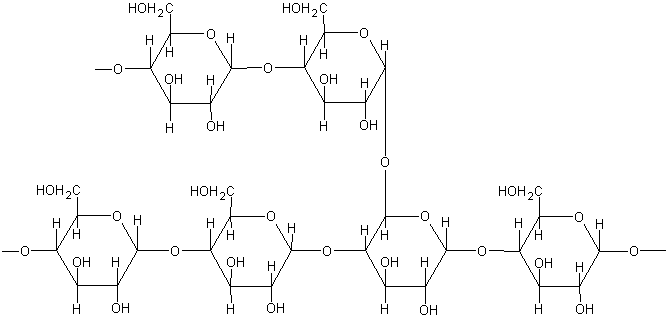
Starch is not really a molecule, but a grain formed by two different kinds of molecules: Amylose and Amylopectin

Amylose

Amylose is a linear molecule formed by glucose units linked by alpha-1, 4 O glycosidic linkages. Taking in account the kind of linkage we can say that the repeating unit in amylose is maltose. (It explains that some books indicate that the monomeric unit in amylose is maltose).

Amylose molecule is helicoidal

Amylopectin

Amylopectin is the second type of molecule that forms starch. It is a branched molecule, formed also by glucose. Amylopectin contains D-glucose residues bonded together by a(1, 4)-O-glycosidic linkages with branching through a(1 6)-O-glycosidic linkages.

The disaccharides that can be obtained from the digestion of amylopectin are maltose and isomaltose.

Amylopectin shows a branch each 24-30 units of glucose,

Glycogen

The structure of glycogen is very similar to amylopectin but more branched, with one branch every 8 to 12 glucose unit

Glycogen is the way in which glucose is stored in animals. Glycogen is stored mainly in liver (to release glucose to blood when necessary) and in muscle, where it is used as a reserve of energy for muscular contraction (Answer to C-o8)

HETEROPOLYSACCHARIDES

Heteropolysaccarides contain two or more different kind of monosaccharides. Usually they provide extracellular support for organisms of all kingdoms: the bacteria cell envelope, or the matrix that holds individual cells together in animal tissues, and provides protection, shape and support to cells, tissues and organs.

Heteropolysaccharides provide extracellular support to very different organisms, from bacteria to humans; together with fibrous proteins, like collagen, elastin, fibronectin, laminin and others, heteropolysaccharides are the most important components of the extracellular matrix.  Hyaluronic acid, condroitin sulfates and dermatan sulfates are important heteropolysaccharides in the extracellular matrix. These heteropolysaccharides usually are formed by the repetition of a disaccharide unit of an aminosugar and an acid sugar. 

A typical example

Other common constituents are sulfate groups linked to certain monosaccharides. Usually heteropolysaccharides are associated with proteins forming proteoglycans, glycosaminoglycans or mucopolysaccharides (since they are abundant in mucous secretions). As a group, they perform diverse functions: structural, water metabolism regulation (as a reservoir of water), cellular cement, biological sieve, biological lubricant, docking sites for growth factors, among other functions.

Established specific functions of some glycosaminoglycans are:

Hyaluronic Acid (Hyaluronate): It is a lubricant in the synovial fluid of joints,

give consistency to vitreous humor, contributes to tensile strength and elasticity of cartilages and tendons (Answer to C-O6)

Chondroitin Sulfates: contributes to tensile strength and elasticity of cartilages, tendons, ligaments and walls of aorta.

Dermatan sulfate (former chondroitin sulfate B) is found mainly in skin, but also is in vessels, heart, lungs. It may be related to coagulation and vascular diseases and other conditions.

Keratan sulfate: Present in cornea, cartilage bone and a variety of other structures as nails and hair.

Heparin

It is a potent natural anticoagulant produced in the Mast Cells that causes antithrombin bind to thrombin and produce inhibition of blood coagulation.

Glycosaminoglycans are synthesized in the ER and Golgi. They are degraded by lysosomal hydrolases. A deficiency of one of the hydrolases results in a mucopolysaccharidosis. These are hereditary disorders in which glycosaminoglycans accumulate in tissues, causing symptoms such as skeletal and extracellular matrix deformities, and mental retardation.

Examples of these genetic diseases are Hunter and Hurler syndromes.

These diseases, caused by different enzyme deficits, are characterized by physical deformities, mental retardation and disturbances in the degradation of heparan sulfate and dermatan sulfate.

Biochemistry Questions: Carbohydrates and Medicine

Question:

A 15-year-old black male patient complains that lately, after the ingestion of dairy products, he experiences bloating, cramps and flatulence, and sometimes diarrhea. With this information, it is reasonable to think that the patient is intolerant to:

a) cellobiose

b) lactose

c) mannose

d) sucrose

e) maltose

f) isomaltose

g) fructose

Solution:

(b) lactose

Lactose is the milk sugar.

It is formed by Beta-D galactose and D-glucose. The galactose is linked to the glucose through a beta 1,4-O-glycosidic linkage.

This linkage is hydrolyzed by a specific disaccharidase called Lactase, located in the brush border of the epithelial cells of the small intestine. The glucose and galactose are absorbed and transported through the portal system to the liver.

In spite of the common believe in developed countries, that consume great amounts of dairy products, most of the humanity are glucose intolerant. Human beings show a decrease in the synthesis of lactase after the 4 years of age. In persons with primary lactose intolerance (the “physiological” one we are talking about), this decrease is usually evident after 6 years of age, in some cases after puberty, and most of the lactose contained in the ingested food remain undigested and continue to the large intestine. where it is fermented by intestinal bacteria, producing gases, organic acids and a decrease in the pH.

It can be manifested with cramps, abdominal pain, and other gastrointestinal disorders, that begin 1 to 2 hours after the ingestion of dairy products. This condition is more frequent among Afro American than among white Americans.

Another kinds of Lactose intolerance are a congenital form, very rare, and lactose intolerance secondary to intestine diseases, including infections.

In fact, primary lactose intolerance can be hardly considered a disease, since there is a genetic programmed decrease in the synthesis of lactase (Humans were not ‘supposed” to drink milk after a few months of life!). Since around 70 % of the whole population is lactose intolerant, it has been proposed that lactose intolerance should be considered the norm, and that the minority should be considered as a lactase persistent group, that appeared as mutation of the “normal” gen.

Anyway, for those persons living in a society where milk is an important componente of diet, to be intolerant to lactose convey certain minor problems.

The “treatment” consist mainly in avoiding lactose containing products (but recall to supplement calcium and other minerals usually associated to dairy products!)

More information about this condition can be found in:

National Digestive Diseases Information Clearinghouse.

Policy of the American Academy of Pediatrics about Lactose Intolerance (2006)

Marks, J.W.: Lactose intolerance (Lactase deficiency)

Swagerty, D.L.; Walling, A.D.; Klein, R.M.: Lactose Intolerance

Guandalini, S.: Lactose Intolerance

Thursday, March 1, 2012

Biology Career booklet from Biochemistry Den

"Career Guide for Biology students" ebook is the inspirative collection for students in india. I have mentioned in this ebook, how to choose the courses in higher education & its prospectus. Here i have given detailed information on "Education and Prospects of Some Innovative courses". I think these are very useful to Students and for Lecturers (to promote students for higher education). Just refer the site or promote or distribute the copy to your friends and help them. Thank you."

From Your Den 


DOWNLOAD
 the FREE ebook

Saturday, February 18, 2012

Biochemistry MCQ Examinations 1

Ninhydrin test or Ninhydrin reagent

Ninhydrin (2,2-Dihydroxyindane-1,3-dione) is a chemical used to detect ammonia or primary and secondary amines. When reacting with these free amines, a deep blue or purple color known as Ruhemann's purple is produced. Ninhydrin is most commonly used to detect fingerprints, as the terminal amines or lysine residues in peptides and proteins sloughed off in fingerprints react with ninhydrin.

Ninhydrin can also be used to monitor deprotection in solid phase peptide synthesis (Kaiser Test). The chain is linked via its C-terminus to the solid support, with the N-terminus extending off it. When that nitrogen is deprotected, a ninhydrin test yields blue. Amino-acid residues are attached with their N-terminus protected, so if the next residue has been successfully coupled onto the chain, the test gives a colorless or yellow result.

Ninhydrin is also used in amino acid analysis of proteins: Most of the amino acids are hydrolyzed and reacted with ninhydrin except proline; Also, certain amino acid chains are degraded. Therefore, separate analysis is required for identifying such amino acids that either react differently or don't react at all with ninhydrin. The rest of the amino acids are then quantified colorimetrically after separation by chromatography.
A solution suspected of containing the ammonium ion can be tested by ninhydrin by dotting it onto a solid support (such as silica gel); treatment with ninhydrin should result in a dramatic purple color if the solution contains this species. In the analysis of a chemical reaction by thin layer chromatography (TLC), the reagent can also be used. It will detect, on the TLC plate, virtually all amines, carbamates and also, after vigorous heating, amides.

When ninhydrin reacts with amino acids, the reaction also releases CO2. The carbon in this CO2 originates from the carboxyl carbon of the amino acid. This reaction has been used to release the carboxyl carbons of bone collagen from ancient bones for stable isotope analysis in order to help reconstruct the palaeodiet of cave bears.

A ninhydrin solution is commonly used by forensic investigators in the analysis of latent fingerprints on porous surfaces such as paper. Amino acid containing fingermarks, formed by minute sweat secretions which gather on the finger's unique ridges, are treated with the ninhydrin solution which turns the amino acid finger ridge patterns purple and therefore visible.

The carbon atom of a carbonyl bears a partial positive charge enhanced by neighboring electron withdrawing groups like carbonyl itself. So the central carbon of a 1,2,3-tricarbonyl compound is much more electrophilic than one in a simple ketone. Thus indane-1,2,3-trione reacts readily with nucleophiles, including water. Whereas for most carbonyl compounds, a carbonyl form is more stable than a product of water addition (hydrate), ninhydrin forms a stable hydrate of the central carbon because of the destabilizing effect of the adjacent carbonyl groups.
Note that in order to generate the ninhydrin chromophore, the amine is condensed with a molecule of ninhydrin to give a Schiff base. Thus only ammonia and primary amines can proceed past this step. At this step, there must also be an alpha proton (H* in the diagram) for Schiff base transfer, so an amine adjacent to a tertiary carbon cannot be detected by the ninhydrin test. The reaction of ninhydrin with secondary amines gives an iminium salt, which is also coloured, and this is generally yellow-orange in color.

image

Tuesday, February 7, 2012

Study Materials: Biological Oxidation by Satish @Biochemistry den

Study Materials: Biological Oxidation by Satish @Biochemistry den
Read and Download the Materials from Here


BIOLOGICAL OXIDATION -

Study Materials: DNA Replication Full by Satish@Biochemistry Den

Study Materials: DNA Replication Full by Satish@Biochemistry Den
Read & Download the material from here


DNA Replication study materials -

Study Materials: Cells of the Immune System@biochemistryden

Study Materials: Cells of the Immune System
Read and Download the file from Here


Cells of the Immune System -

Study Material: Plasma Proteins and role in Health and disease

Study Material:  Plasma Proteins and role in Health and disease
Read & Download the study material from here


Plasma Proteins & Anemia -


Study Material: Photosynthesis by Satish

Study Material: Photosynthesis by Satish
Read and Download from here


Photosynthesis -


Study Material: Elements of Immunity@Biochemistry den

Study Material:  Elements of Immunity
Read and Download the document fro here


Elements of Immunity -

Study material: Recombinant DNA Technology

Study material: Recombinant DNA Technology from Satish
Read & Download from here


rDNA technology-Biochemden -

Thursday, December 22, 2011

CSIR UGC NET Life Science December 2011 Exam Key

CSIR UGC NET Life Science December 2011 Exam conducted on 18th December 2011 (Sunday). The result released from IAFS.

Just Visit the link and get your copy.
Download from this link

CSIR UGC NET Life science Dec 2011 Exam Paper & key

Monday, October 31, 2011

Education in Biology & Job prospectus

Education in Biology & Job prospectus
Biology is the study of life. This is one of the amazing future. most of the peoples are going through common routes in their higher educations. It is very good. But i am trying to introduce few of the good courses in job oriented. They are


4.Education in Bioinformatics & Job prospectus 
(Link will update soon)

Do not forget to visit BIOCHEMISTRY DEN official site for latest information

Tuesday, September 27, 2011

An Introduction to Genetic Analysis by Griffith (8th Edition) ebook

Below is the review of Free Ebook: An Introduction to Genetic Analysis by Griffith (8th Edition):
 
Ebook‘s Description
An Introduction to Genetic Analysis (IGA) stands out from its peers in this course in that it provides a clear introduction to the techniques and experiments of scientists past and present, not just an “encyclopedia” of information.
This experimental emphasis, together with a solid pedagogical framework in the chapters, provides the clearest, most cutting-edge text available.
IGA is also well-known for its outstanding problem sets, an integral part of the genetics course at any school.

Ebook‘s  Details:
  • Hardcover: 800 pages
  • Publisher: W. H. Freeman; Eighth Edition edition (April 23, 2004)
  • Language: English
  • ISBN-10: 0716749394
  • ISBN-13: 978-0716749394

Tuesday, August 23, 2011

CSIR UGC NET JRF December 2011 Notification / Apply online


CSIR will hold the Joint CSIR-UGC Test on 18th December, 2011 for determining the eligibility of the Indian National candidates for the award of Junior Research Fellowships (JRF) NET and for determining eligibility for appointment of Lecturers (NET) in certain subject areas falling under the faculty of Science. The award of Junior Research Fellowship (NET) to the successful eligible candidates will depend on their finding admission/placement in a university/ national laboratory/ institution of higher learning and research, as applicable.
  • Junior Research Fellowships (NET)
  • Lecturers (NET)
Educational Qualification:
M.Sc. or Equivalent degree under the subjects mentioned in para 2.1 above, with minimum 55% marks for General & OBC candidates; 50% for SC/ST candidates, Physically and Visually Handicapped candidates and Ph.D. degree holders who had passed Master's degree prior to 19th September 1991.
A candidate can also apply for the Test under RA (Result Awaited) category, if he/she is appearing or has appeared in his/her final year (Last Semester where Semester system is there) of M.Sc. OR equivalent Degree Examination in subjects mentioned in para 2.1 above during the academic Session 2011-2012. Such candidates will have to submit the attestation format (given at the reverse of the application form) duly certified by the Head of the Deptt./Institute over his/her signature and rubber stamp (with address and name) from where the candidate is appearing or has appeared in the final year(Last Semester where Semester system is there) M.Sc. or equivalent degree examination. However, such candidates shall be admitted to the Test provisionally. 

They shall only be considered eligible for JRF-(NET)/LS-(NET), if they are able to produce the proof of having passed the Master’s Degree examination in the relevant or related subject with the requisite percentage of marks and within the stipulated IMPORTANT DATES time frame. Students enrolled in integrated MS-Ph D. program are also eligible to apply for JRF in subject areas of NET. Their eligibility for Lectureship will be subject to fulfilling the criteria laid down by UGC.

Subjects of The Test:
The Test will be held in the subjects as given under:
  • Chemical Sciences,
  • Earth Sciences
  • Life Sciences
  • Mathematical Sciences
  • Physical Sciences
Age Limit:
  • For JRF (NET): Minimum 19 Years and maximum 28 years as on 01-07-2011 (upper age limit may be relaxed up to 5 years as in case of candidates belonging to SC/ST/OBC(Non Creamy Layer), Physically handicapped/Visually handicapped and female applicants).
  • For LS (NET): Minimum 19 years, as on 01.07.2011. No upper age limit.
Date and Scheme of the Test:
The single paper MCQ based test will be held on Sunday, the 18th December, 2011 as under:

Morning Session:
Subject
Marks
Timings
Duration
(i) Life Sciences
(ii) Mathematical Sciences
200
9.00AM-12.00PM
3 hrs

Afternoon Session:
Subject
Marks
Timings
Duration
(i) Chemical Sciences
(ii) Earth, Atmospheric, Ocean and Planetary Sciences
(iii) Physical Sciences
200
2.00 PM-5.00 PM
3 hrs

Syllabus of the Test:
The question paper shall be divided into three parts, (A, B & C) as per syllabus & Scheme of Exam.
  • Part 'A' shall be common to all subjects. This part shall contain questions pertaining to General Science, Quantitative Reasoning & Analysis and Research Aptitude.
  • Part 'B' shall contain subject-related conventional Multiple Choice questions (MCQs), generally covering the topics given in the syllabus.
  • Part 'C' shall contain higher value questions that may test the candidate's knowledge of scientific concepts and/or application of the scientific concepts. The questions shall be of analytical nature where a candidate is expected to apply the scientific knowledge to arrive at the solution to the given scientific problem.
  • Negative marking for wrong answers, wherever required, shall be applicable as per scheme of Exam. Syllabus & Scheme of Exam of single Paper is given in the Information Bulletin for this test at Annexure "A" and may also be seen at CSIR website: www.csirhrdg.res.in
Examination Centers:
The test will be held at 26 Centers spread all over India, as specified below:
Bangalore, Bhavnagar, Bhopal, Bhubaneshwar, Chandigarh, Chennai, Cochin, Delhi, Guntur, Guwahati, Hyderabad, Imphal, Jammu, Jamshedpur, Karaikudi, Kolkata, Lucknow, Nagpur, Pilani, Pune, Raipur Roorkee, Srinagar, Thiruvananthapuram, Udaipur and Varanasi.

For more info please visit this Link:

(Just click this link and get CSIR old papers with key and Study materials absolutely FREE  FREE)

Wednesday, June 8, 2011

Protein folding made easy

Protein folding has nothing to do with laundry. It is, in fact, one of the central questions in biochemistry. Protein folding is the continual and universal process whereby the long, coiled strings of amino acids that make up proteins in all living things fold into more complex three-dimensional structures. By understanding how proteins fold, and what structures they are likely to assume in their final form, researchers are then able to move closer to predicting their function.


This is important because incorrectly folded proteins in humans result in such devastating diseases as Alzheimer's, Parkinson's, Huntington's, emphysema and cystic fibrosis. Developing better modelling techniques for protein folding is crucial to creating more effective pharmaceutical treatments for these and other diseases.

Computational methods of modelling protein folding have existed for a couple of decades. But what McGill researcher Jérôme Waldispühl of the McGill Centre for Bioinformatics has done, working with collaborators from MIT, is to develop algorithms that can work from a laptop computer to examine a protein's fundamental chemical properties and then scan a number of possible protein shapes before predicting the final form that the protein is likely to take.

The results have been impressive. Whereas classical techniques for predicting protein folding pathways required hundreds of thousands of CPU hours to compute the folding dynamics of 40 amino acids proteins, the program tFolder implemented by Solomon Shenker – a former McGill under-graduate student now at Cornell – has been able to predict correctly in 10 minutes on a single laptop, a coarse-grained representation of the folding pathways of a protein with 60 amino acids.

Waldispühl and his students continue to work on their algorithm to improve its success rate at predicting protein folding with broader categories of proteins including some that are important in DNA-binding. The research was recently presented at the 15th Annual International Conference in Research in Computational Molecular Biology (RECOMB 2011).

Heaviest element officially named Copernicium

Label follows tradition of naming elements after merited scientists 


The heaviest element yet known is now officially named "Copernicium," after the astronomer Nicolaus Copernicus. Copernicium has the atomic number 112 — this number denotes the number of protons in the nucleus of an atom. It is 277 times heavier than hydrogen, making it the heaviest element officially recognized by international union for chemistry IUPAC. 

The name for the element was suggested by the team that discovered it, led by Sigurd Hofmann at the GSI Helmholtzzentrum für Schwerionenforschung in Germany. The suggested name "Copernicium" in honor of Nicolaus Copernicus (1473-1543) follows the tradition of naming chemical elements after merited scientists.

IUPAC officially announced the endorsement of the new element's name on Feb. 19, Nicolaus Copernicus' birthday. Copernicus' work in the field of astronomy is the basis for our modern, heliocentric world view, which states that the sun is the center of our solar system with Earth and all the other planets (in our solar system) circling around it.

On the periodic table of elements, Copernicium will have the symbol "Cn." The team had originally suggested "Cp" as the element's symbol, but because this abbreviation has other uses in science (such as a material's specific heat), the team agreed to "Cn."

Other elements named for famous scientists include: Einsteinium (for Albert Einstein), Fermium (for nuclear physicist Enrico Fermi), and Curium (after Marie Curie and her husband Pierre).

Hofmann and his team were able to produce the element Copernicium at GSI for the first time on Feb. 9, 1996. Using the 100-meter long GSI accelerator (an atom smasher), they fired zinc ions onto a lead foil. The fusion of the atomic nuclei of the two elements produced an atom of the new element 112. But the atom was only stable for a fraction of a second.

Further independent experiments confirmed the discovery of the element. Last year, IUPAC officially recognized the existence of element 112, acknowledged the GSI team’s discovery and invited them to propose a name.

Periodic table gains two elements


Chemistry officials have confirmed the creation of two new elements - so now names will be given to elements 114 and 116.

By John Roach

The periodic table has two new heavyweights, elements 114 and 116, according to a committee of  international chemists and physicists. The elements are fleeting — they are created by bombarding lighter elements together and exist for less than a second before undergoing radioactive decay. Such a short lifespan means that we can't say much about them other than they really do exist.

"The lifetimes of these things have to be reasonably long so you can study the chemistry — meaning, pushing a minute," Paul Karol  of Carnegie Mellon University in Pittsburgh, who chaired the committee that approved the new elements, told New Scientist.

The evidence for element's existence has been mounting for more than a decade. In 1999, for example, Russian scientists with the Joint Institute for Nuclear Research bombarded plutonium-244 with calcium-48 to produce a single atom of 114, which has an atomic weight of 289.

Further collaboration between Russian and U.S. scientists at the Lawrence Livermore National Laboratory resulted in papers published in 2004 and 2006 on the creation of the elements 114, 116, and the yet-to-be-approved 118.

To create 116, the researchers smashed together curium atoms, which have 96 protons in their nucleui, with calcium nuclei, which have 20 protons. This lasted a few milliseconds before decaying into 114, which in turn decayed into copernicum, element 112.

These papers served as the basis for review by the International Union of Pure and Applied Chemistry, which made the formal announcement of the new elements on June 1 with the publication of a paper in Pure Applied Chemistry.

The elements currently go by the placeholder names ununquadium and unuhexium, which by IUPAC convention are derived from the digits 114 and 116. The Russian discovery team at JINR has proposed flerovium for 114, after Soviet element finder Georgy Flyorov, and muscovium for 116, after Russia's Moscow region, according to Wired.

The committee also reviewed claims associated with elements 113, 115, and 118, but found they are not yet conclusive and thus do not meet the criteria for discovery. For more information on how the elements were discovered and the review process, check out the video above from the University of Nottingham's Periodic Table of Videos series.

LinkWithin

Related Posts Plugin for WordPress, Blogger...